
PPWR and Luxury Packaging: What European Brands Need to Know
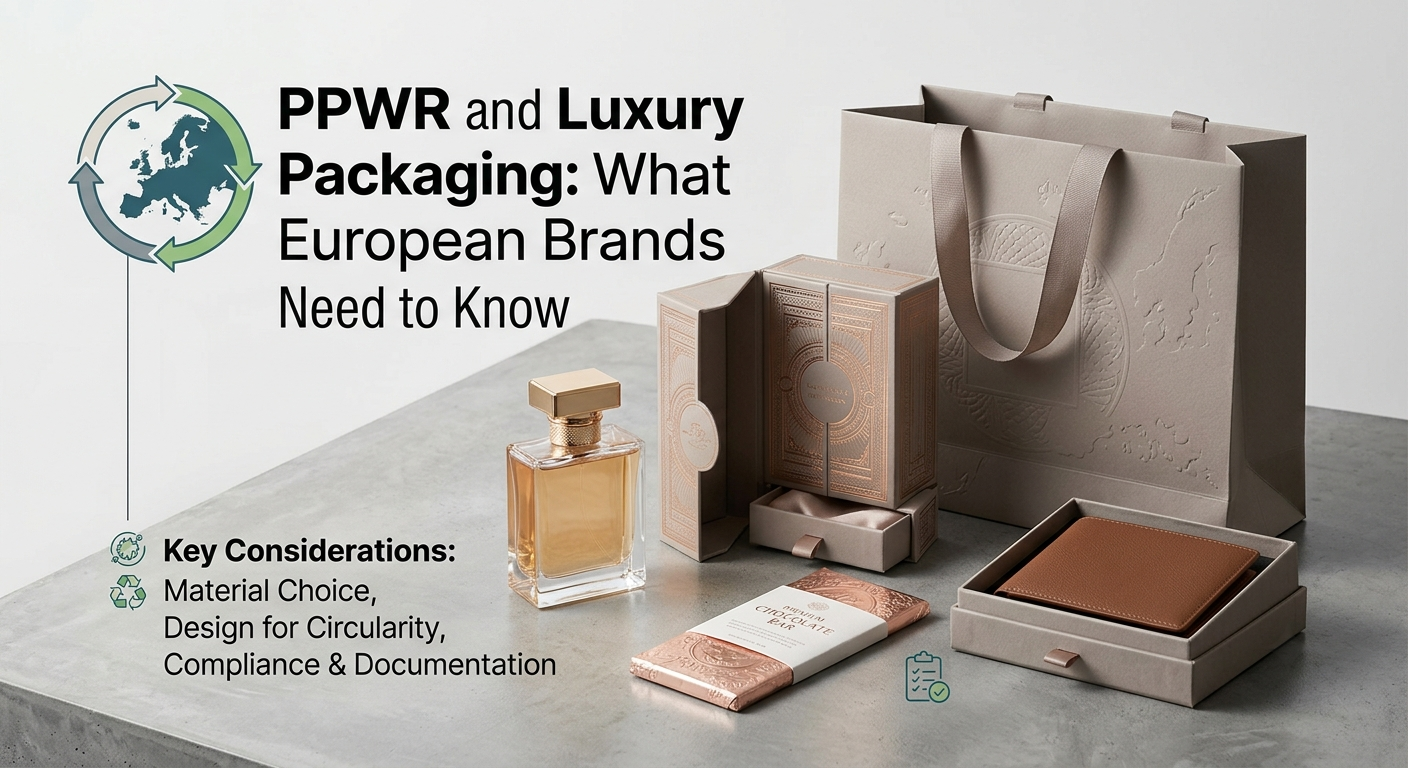
The European packaging landscape is changing. Here’s what the EU Packaging and Packaging Waste Regulation (PPWR) means for luxury rigid boxes—and how brands and packaging manufacturers can prepare.
For luxury brands, packaging is part of the product experience. The texture of the paper, the precision of the construction, the opening experience, the finishing details and even the weight of the box contribute to how a product is perceived.
At the same time, packaging is under increasing pressure to become more circular.
The European Union’s Packaging and Packaging Waste Regulation (PPWR) introduces a new framework for packaging placed on the EU market, covering areas including packaging design, recyclability, waste prevention, recycled content, reuse and information requirements.
For luxury packaging manufacturers, this creates an important question:
Can premium packaging remain luxurious while becoming better aligned with the circular economy?
At Bell Printers, we believe the answer lies in better packaging engineering—not simply using fewer materials.
What is PPWR?
The Packaging and Packaging Waste Regulation (EU) 2025/40, commonly known as PPWR, is the European Union’s new regulation for packaging and packaging waste.
It entered into force in February 2025 and began applying from 12 August 2026.
One of its major long-term objectives is to ensure that packaging placed on the EU market becomes increasingly recyclable and that packaging waste is reduced.
The regulation addresses different aspects of packaging throughout its lifecycle, including:
- 1.Packaging design
- 2.Recyclability
- 3.Material composition
- 4.Packaging waste prevention
- 5.Recycled content requirements for certain packaging
- 6.Reuse and refill
- 7.Labelling and information
- 8.Substances of concern
- 9.Producer responsibilities
For brands selling products in Europe, packaging can therefore no longer be considered only a design or purchasing decision.
It increasingly becomes a product-development and compliance consideration.
Why PPWR Matters for Luxury Rigid Boxes
Luxury rigid boxes are often more complex than conventional folding cartons.
A typical premium rigid box may contain:
- 1.Greyboard or paperboard
- 2.Decorative paper
- 3.Printing
- 4.Coatings
- 5.Foils
- 6.Laminations
- 7.Adhesives
- 8.Magnets
- 9.Ribbons
- 10.Windows
- 11.Foam or other inserts
- 12.Plastic components
- 13.Decorative accessories
Every additional component can influence the overall packaging construction.
Every additional component can influence the overall packaging construction.
That means a luxury box should not be evaluated simply by asking:
“Is the box made of paper?”
A better question is:
“What is the complete packaging construction, and how does each component affect its end-of-life pathway and applicable requirements?”
This is where packaging engineering becomes important.
The New Opportunity: Circular Luxury Packaging
Sustainability and luxury are sometimes presented as opposites.
Luxury packaging is expected to feel substantial, sophisticated and visually distinctive.
Circular packaging, meanwhile, is often associated with minimalism and material reduction.
But these two ideas do not necessarily have to conflict.
The opportunity is to engineer premium packaging differently.
Instead of asking:
How can we make a luxury box look sustainable?
we should ask:
How can we design a luxury box whose materials, construction and functionality are considered with circularity from the beginning?
This can influence decisions at every stage—from structural design to material selection and finishing.
From Design to Documentation
A PPWR-aware packaging development process can begin much earlier than production.
At Bell, we see four important stages:
1. Design
The packaging structure is evaluated before sampling.
Questions can include:
- 1.How many components are necessary?
- 2.Can unnecessary material be eliminated?
- 3.Can the structure be simplified?
- 4.Are different materials being combined unnecessarily?
- 5.Can the required luxury appearance be achieved through a simpler construction?
2. Material Selection
The materials used in the box need to be identified and documented.
This can include:
- 1.Board
- 2.Paper
- 3.Adhesives
- 4.Coatings
- 5.Foils
- 6.Plastics
- 7.Windows
- 8.Inserts
- 9.Closures
- 10.Decorative components
Supplier information becomes increasingly valuable at this stage.
3. Validation
The proposed construction can be evaluated against the applicable packaging requirements and relevant recyclability criteria.
The objective is not simply to make a claim.
It is to understand the packaging construction and establish evidence.
4. Documentation
A structured technical file can bring the information together.
Depending on the packaging and the applicable responsibilities, documentation may include:
- 1.Material specifications
- 2.Bill of materials
- 3.Component weights
- 4.Supplier information
- 5.Recycled-content information where applicable
- 6.Construction drawings
- 7.Relevant technical information
- 8.Recyclability assessment
- 9.Conformity documentation where required
This approach can help brands make better packaging decisions before a design reaches large-scale production.
What Does “PPWR-Ready” Mean?
The phrase PPWR-ready should not be treated as a substitute for formal compliance.
A packaging manufacturer should avoid making blanket claims such as:
“100% PPWR compliant”
without having established the applicable requirements and supporting evidence.
Instead, PPWR readiness can describe a structured approach in which packaging is:
- 1.Designed with applicable PPWR requirements in mind
- 2.Built using identified and documented materials
- 3.Evaluated for relevant recyclability considerations
- 4.Supported by supplier information
- 5.Accompanied by appropriate technical documentation
The exact compliance obligations depend on the packaging, application, economic operator and the specific PPWR requirements that apply.
What This Means for European Brands
For European brands, PPWR creates an opportunity to bring packaging teams and suppliers into the sustainability conversation much earlier.
Instead of waiting until a finished package is produced, brands can ask packaging manufacturers:
“What is this box made of?”
“How much does each component weigh?”
“What materials are being combined?”
“What documentation can you provide?”
“Can we simplify the construction without compromising the brand experience?”
“Has the packaging been assessed against the applicable recyclability requirements?”
These questions can become part of the packaging development brief.
Bell’s Approach to PPWR-Ready Luxury Packaging
At Bell Printers, our focus is luxury rigid packaging.
Our approach is to bring circularity considerations into the packaging-development process while protecting the qualities that make premium packaging valuable.
We look at the packaging as a complete system:
Structure → Materials → Printing → Finishing → Components → Manufacturing → End-of-Life Considerations → Documentation
This allows our design, sample-making, production and procurement teams to work together rather than treating sustainability as an afterthought.
Building a Circular Materials Library
One of the foundations of PPWR-ready packaging is better material information.
A packaging manufacturer can build a structured materials library containing information such as:
- 1.Board specifications
- 2.Paper specifications
- 3.Material composition
- 4.Recycled content where applicable
- 5.Supplier information
- 6.Adhesive specifications
- 7.Plastic polymer types
- 8.Component weights
- 9.Technical documentation
- 10.Relevant certifications
This creates a stronger foundation for packaging development.
It also allows brands to make informed trade-offs between appearance, performance, cost and circularity.
Luxury Doesn’t Have to Look Less Premium
A common misconception is that more sustainable packaging must look plain.
That isn’t necessarily the case.
Luxury can come from:
- 1.Structural precision
- 2.Tactile papers
- 3.Sophisticated typography
- 4.Controlled use of colour
- 5.Embossing
- 6.Debossing
- 7.Foiling
- 8.High-quality printing
- 9.Intelligent opening mechanisms
- 10.Attention to detail
The challenge is to determine which elements genuinely add value to the customer experience and which can be reconsidered.
The future of luxury packaging may therefore not be about adding more.
It may be about engineering better.
Preparing Your Packaging for Europe’s Next Chapter
PPWR represents a significant change in the way packaging is designed, manufactured and managed in Europe.
For brands, the most practical starting point is understanding the construction of the packaging they already use.
Ask:
What materials are in our packaging?
How much of each material is used?
Which components are essential?
Which components could be redesigned?
What information is available from our suppliers?
What documentation will we need?
Starting these conversations early gives brands and packaging manufacturers more opportunities to innovate.
Bell Printers: Luxury Packaging with a Circular Mindset
For more than four decades, Bell Printers has developed premium and luxury packaging solutions for brands across global markets.
Our focus is to combine design, structural engineering, manufacturing capability and material knowledge to create packaging that delivers both a premium brand experience and a more considered approach to packaging sustainability.
As the European packaging landscape evolves, we are developing our capabilities around PPWR-aware luxury packaging, helping brands explore packaging constructions that consider recyclability, material efficiency and documentation without losing the premium character of the package.
Looking for a PPWR-ready luxury packaging partner?
Talk to Bell Printers about your next European packaging project.